
Play Dice Now!
Home → Similar Games
Games Similar to Dice
Games close to Dice
Dice is a single-round prediction game with a maximum win cap of x970, which stands significantly below the x1,000,000 ceiling found in Aviator. The latter title from Spribe allows for massive payouts through its climbing multiplier mechanic, whereas Dice limits exposure to a fixed theoretical maximum. High rollers seeking life-changing sums will find the ceiling in Dice restrictive compared to the exponential potential of crash-style games.
Chicken Road by InOut Games offers a max win of x3,608,855, dwarfing the x970 limit inherent to Dice. This comparison highlights the difference between high-variance climbing mechanics and the capped, instant-resolution nature of Dice. Players prioritizing extreme upside over frequent small wins might prefer titles like Chicken Road or Fish Road.
Fish Road provides a maximum win of x2,542,251.93, further illustrating the gap between Dice and other high-stakes instant games. While Dice caps returns at x970 regardless of bet size, these alternatives allow bets to multiply into six-figure sums. The structural difference dictates that Dice suits controlled risk management rather than lottery-style jackpot chasing.
Titles with similar maths
Aviator shares a 97.00% RTP with Dice, indicating identical long-term theoretical return rates despite different gameplay loops. Both games are developed by Spribe and maintain this specific mathematical edge over the house. Players can expect similar variance profiles in terms of bankroll erosion over hundreds of thousands of rounds.
Plane Game also carries a 97.00% RTP, aligning it mathematically with Dice and Aviator within the Spribe portfolio. However, Plane Game is classified as having high volatility, suggesting more erratic payout intervals than the adjustable risk slider in Dice. This distinction affects session planning for players tracking their hit frequency against theoretical returns.
Tower Rush presents a 97.00% RTP but caps its max win at 100x, which is substantially lower than Dice’s x970 limit. This makes Tower Rush a lower-risk alternative for players who want the same studio mathematics but with tighter loss boundaries. The reduced multiplier ceiling changes the risk-reward ratio compared to the higher cap available in Dice.
Same studio alternatives
Spribe develops both Dice and Aviator, ensuring consistent provably fair technology across their portfolio. Aviator features a 97.00% RTP and a massive x1,000,000 max win, contrasting with Dice’s x970 cap. Players familiar with Spribe’s algorithmic transparency may switch between these titles without learning new verification methods.
Plane Game is another Spribe release with a 97.00% RTP, matching Dice’s theoretical return percentage exactly. While Dice uses an adjustable win-chance slider, Plane Game relies on a climbing multiplier model with high volatility. The shared developer background means deposit methods and account structures remain identical for users switching between these products.
The common studio ensures that all three titles utilize the same underlying security infrastructure for round outcomes. Dice offers a bet range from $0.10 to $100, while Aviator and Plane Game often support higher stakes for high rollers. The mathematical consistency allows analysts to compare performance metrics directly across the Spribe suite.
Comparable volatility
Dice features adjustable volatility, allowing players to set their own risk parameters via the win-chance slider. This contrasts with Plane Game, which has fixed high volatility determined by its climbing multiplier mechanics. High rollers can mimic high-volatility behavior in Dice by targeting low-probability multipliers near the x970 cap.
Aviator operates with implicit high volatility due to its potential for rapid crashes, unlike the user-controlled risk in Dice. Both games share a 97.00% RTP, but the distribution of wins differs significantly between the two models. Players must adjust their bankroll management strategies to accommodate the unpredictable nature of Aviator versus the calculated probabilities of Dice.
Tower Rush offers a 97.00% RTP with a fixed max win of 100x, creating a lower volatility profile than Dice’s upper limit. The capped returns in Tower Rush reduce the swing amplitude compared to the x970 possibility in Dice. Analysts note that adjustable volatility in Dice provides greater flexibility for managing variance than the static models used in many competitor titles.
Comparable return figures
Dice maintains a 97.00% RTP, identical to the theoretical return of Aviator and Plane Game. This figure represents a 3.00% house edge, which is standard for high-quality instant games in the market. High rollers should calculate expected loss based on this percentage when comparing turnover across different Spribe titles.
Chicken Road deviates with a 98.00% RTP, offering a lower house edge than the 97.00% found in Dice. This 1.00% improvement in theoretical return makes Chicken Road mathematically superior for long-term play despite its different mechanics. Players comparing return figures will notice this slight advantage when balancing their portfolio across different providers.
Fish Road carries a 96.00% RTP, which is one percentage point lower than the 97.00% RTP of Dice. This higher house edge means Dice offers better long-term value for players tracking theoretical returns. The comparison confirms that while max wins vary wildly, the base mathematical advantage remains a critical factor for serious gamblers.
Dice compared with similar titles
| Game | Studio | RTP | Volatility | Max win |
|---|---|---|---|---|
| Dice | Spribe | 97.00% | adjustable | x970 |
| Tower Rush | Galaxsys | 97.00% | — | 100x |
| Chicken Road | InOut Games | 98.00% | — | x3,608,855 |
| Fish Road | InOut Games | 96.00% | — | x2,542,251.93 |
| Aviator | Spribe | 97.00% | — | x1,000,000 |
| Rabbit Road | InOut Games | 95.50% | — | x3,608,855 |
| Chicken Road 2 | InOut Games | 95.50% | medium | x3,608,855 |
How these titles differ
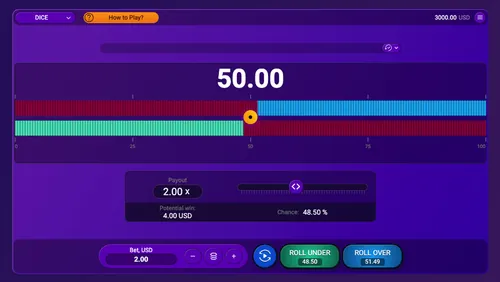
Dice by Spribe operates as a single-round prediction game where the player selects a target number on a 0.00-99.99 range and bets whether the outcome lands higher or lower, with an adjustable win-chance slider determining the multiplier from 1.1x up to 970x. In contrast, Rabbit Road and Chicken Road 2 utilize climbing-multiplier mechanics developed by InOut Games, featuring significantly higher maximum wins of x3,608,855 compared to Dice's capped x970. This structural difference means Dice offers instant, verifiable results via server and client seeds without live cash-out phases during rounds.
Mines and Plinko share Dice's theoretical return to player (RTP) rate of 97.00%, ensuring identical long-term house edges of 3.00% across these specific studio-published titles. Unlike Chicken Dash by TaDa Gaming, which maintains a lower RTP of 96.85% and high volatility, Dice allows players to manually adjust volatility through its risk slider before each bet is placed.
Dice distinguishes itself from slot-style crash games by eliminating reels, paylines, and spinning animations entirely, focusing solely on a rising multiplier that must be cashed out before termination. While Chicken Road 2 and Rabbit Road offer massive potential payouts up to x3,608,855, Dice caps its maximum win at x970, limiting exposure for high rollers seeking controlled variance. This approach aligns with a strategy of consistent, smaller multipliers rather than the rare, extreme jackpots found in InOut Games' portfolio.
Feature sets side by side
The core mechanic of Dice involves setting a precise probability threshold between 0.00 and 99.99, directly linking the win chance to the payout multiplier ranging from 1.1x to 970x. Spribe implements a provably fair system using server and client seeds plus a nonce, allowing independent verification of each round's integrity against the generated outcome. This technical framework provides transparency comparable to Mines and Plinko, which also maintain 97.00% RTP but lack the explicit manual probability slider interface found in Dice.
Auto-bet options are integrated into Dice, enabling users to configure consecutive rounds with predefined stop-loss or win-limit conditions, a feature essential for high-volume betting strategies. Unlike Chicken Dash, which operates on fixed high-volatility parameters set by TaDa Gaming, Dice permits dynamic adjustment of risk profiles per session, offering greater flexibility for bankroll management. The instant result nature of the game ensures rapid turnover, contrasting with the slower pacing often associated with climbing-multiplier formats like Rabbit Road.
Dice excludes traditional bonus features such as free spins or scatter symbols, replacing them with a straightforward mathematical model where the house edge remains constant at 3.00%. Rabbits Road and Chicken Road 2 introduce narrative elements and escalating risks inherent to their climbing structures, differing fundamentally from Dice's static prediction environment. This simplicity reduces cognitive load for experienced players who prefer analyzing probability distributions over complex visual reward sequences.
The absence of wild symbols or progressive jackpots in Dice keeps the focus strictly on statistical expectation, appealing to players who prioritize predictable variance over thematic engagement. While Mines shares the same 97.00% RTP, it introduces grid-based risk discovery, whereas Dice relies purely on numerical thresholds within a linear outcome space. This distinction makes Dice particularly suitable for analytical gamblers who wish to calculate expected value based on exact input parameters.
Payout ceilings compared
Dice imposes a strict maximum win cap of x970, meaning even with optimal probability settings, no single round can yield returns exceeding this multiplier limit. This ceiling stands in stark contrast to Rabbit Road and Chicken Road 2, both capable of delivering massive payouts up to x3,608,855, reflecting their higher risk-reward architecture. For high rollers managing large stakes, this cap limits potential upside but also restricts catastrophic losses relative to the bet size, providing a more contained financial exposure profile.
Chicken Dash by TaDa Gaming offers a maximum win of 20,659x, positioning it between Dice's conservative x970 cap and the extreme highs of InOut Games' titles. Although Mines and Plinko match Dice's 97.00% RTP, they do not specify explicit maximum win multipliers in standard data sheets, leaving their payout structures less defined for comparative analysis. The known cap in Dice allows precise calculation of maximum possible gains, aiding in accurate bankroll forecasting for professional betting operations.
The x970 multiplier in Dice corresponds to a specific low-probability outcome on the 0.00-99.99 scale, requiring players to select targets near the extremes to achieve such returns. In comparison, Chicken Road 2's x3,608,855 potential arises from sequential survival mechanics rather than single-roll probability adjustments, creating fundamentally different risk curves. High rollers utilizing Dice must accept that extreme wealth generation is structurally impossible within its design constraints, favoring steady accumulation over lottery-like windfalls.
Bet ranges compared
Dice supports wager sizes from $0.10 to $100 per round, establishing a moderate entry point that accommodates both casual players and serious high rollers. This range contrasts with many premium crash games that often require minimum bets above $1.00 to access advanced auto-betting features or higher stake tiers. The upper limit of $100 restricts the absolute monetary exposure per spin, though the ability to adjust volatility allows players to effectively scale their risk profile within this financial boundary.
When comparing bet limits to other instant games, the $100 maximum in Dice appears modest against titles like Chicken Road 2, which may support higher stakes due to their different payout architectures. However, the flexibility to alter the win-chance slider enables players to simulate higher volatility effects without increasing the nominal bet amount beyond the $100 cap. This mechanical advantage compensates for the lower maximum stake, allowing sophisticated users to optimize their expected value calculations independently of raw wager size.
The minimum bet of $0.10 facilitates extensive testing of strategies and probability models without significant capital commitment, a feature valuable for verifying the provably fair algorithm's consistency. Unlike slots that might charge fixed costs per line regardless of outcome, Dice charges exactly the wagered amount per round, ensuring transparent cost-per-action metrics. High rollers can leverage the auto-bet function to execute thousands of rounds efficiently, maximizing data collection on the 97.00% RTP performance over time.
Which suits which player
Analytical players who prefer controlling exact probability percentages will find Dice ideal due to its direct input of target numbers and adjustable risk sliders. The game’s lack of visual noise and reliance on pure mathematics appeals to those who distrust RNG opacity, especially given the transparent server-client seed verification process. This demographic typically values the 97.00% RTP and consistent 3.00% house edge over the erratic volatility spikes seen in Chicken Dash or InOut Games.
High rollers seeking substantial but controlled wins may appreciate Dice’s x970 cap as a safeguard against the psychological pressure of chasing infinite multipliers in climbing games. While Rabbit Road offers the allure of x3,608,855, its medium volatility and complex mechanics may deter players focused on quick, decisive outcomes. Dice’s instant resolution and clear mathematical relationship between risk and reward provide a streamlined experience for professionals who prioritize efficiency and transparency.
Casual gamers might find the limited maximum win of x970 less exciting compared to the life-changing potential of Chicken Road 2, potentially reducing long-term engagement. However, the accessible $0.10 minimum bet and simple prediction mechanic lower the barrier to entry, making it suitable for beginners learning about probability theory. The game serves as an educational tool for understanding variance, unlike Mines or Plinko, which introduce additional layers of spatial risk that complicate basic statistical comprehension.
Trying alternatives in demo
Spribe’s Dice offers a theoretical RTP of 97.00%, providing high rollers with a 3.00% house edge that is lower than many traditional slot games. This mathematical advantage allows players to test the adjustable volatility slider in demo mode without risking significant capital during extended sessions. The instant result mechanism ensures that each round concludes immediately, enabling rapid iteration of betting strategies before committing real funds.
The maximum win cap of x970 on Dice is significantly lower than the 5000x potential found in Spaceman by Pragmatic Play or Fortune Rabbit by PG Soft. High-stakes players often compare these limits to determine if the crash genre's ceiling meets their profit targets for single-session variance. Understanding this discrepancy helps players decide whether to stick with Dice’s predictable payout structure or explore higher-risk alternatives.
Demo versions allow users to verify the provably fair algorithm using server and client seeds without financial exposure. This transparency feature is critical for professional gamblers who require mathematical certainty before engaging with real-money bets. Players can adjust the win-chance slider from 1.1x up to 970x to observe how probability shifts impact expected value over hundreds of simulated rounds.
Why variety helps bankroll
Dice restricts bet sizes to a range of $0.10 to $100 per round, which may limit aggressive staking strategies for elite high rollers seeking larger volume exposure. In contrast, platforms offering access to Spaceman or Fortune Rabbit provide different volatility profiles that can better distribute risk across a diversified portfolio. Allocating portions of a bankroll to titles with varying max wins helps mitigate the impact of short-term losing streaks.
The 97.00% RTP of Dice compares favorably against Spaceman’s 96.50% and Fortune Rabbit’s 96.75%, making it statistically more efficient for long-term retention. High rollers benefit from this 0.25% to 0.50% edge differential when calculating expected loss rates over thousands of hands. Maintaining a mix of high-RTP and medium-volatility games ensures that bankroll erosion remains within manageable thresholds during volatile periods.
Adjustable volatility on Dice allows players to switch between conservative and aggressive modes based on current bankroll health. This flexibility contrasts with fixed-variance titles like Fortune Rabbit, which maintains a medium volatility setting regardless of player preference. Strategic variation enables high rollers to preserve capital during downswings while maximizing upside potential during favorable statistical runs.
Studios worth knowing
Spribe developed Dice in 2021, establishing a reputation for instant-result prediction games that prioritize mathematical transparency over graphical complexity. Unlike traditional developers focused on reel mechanics, Spribe’s design philosophy centers on provably fair algorithms and adjustable risk parameters. This approach appeals to data-driven players who value verifiable outcomes over immersive visual narratives.
Pragmatic Play, the creator of Spaceman, brings extensive experience in high-volatility crash games with a 5000x max win potential. Their title differs fundamentally from Dice by employing a climbing-multiplier mechanic rather than a single-round prediction model. Comparing Spribe’s static prediction framework with Pragmatic Play’s dynamic multiplier curve highlights distinct strategic requirements for each studio’s offerings.
PG Soft (Pocket Games Soft) produces Fortune Rabbit, a game featuring a non-standard 3-4-3 row grid and medium volatility settings. While Dice operates without reels or paylines, PG Soft’s title retains traditional slot structures adapted for mobile optimization. High rollers analyzing studio portfolios must distinguish between Spribe’s instant settlement model and PG Soft’s spin-based mechanics to apply appropriate bankroll management techniques.
Newer releases in the genre
Released in 2021, Spribe’s Dice introduced an adjustable win-chance slider that allows precise control over payout multipliers ranging from 1.1x to 970x. This mechanic provides immediate feedback on risk-adjusted returns, contrasting with newer titles that may lock volatility settings at launch. Early adoption of such transparent systems has set a benchmark for fairness verification in the instant game category.
Subsequent releases like Spaceman by Pragmatic Play have expanded the genre’s maximum win potential to 5000x, appealing to players seeking higher variance outcomes. These newer entries often incorporate climbing multipliers that differ structurally from Dice’s single-roll prediction format. Analyzing the evolution from 970x caps to 5000x ceilings reveals shifting player preferences toward higher reward thresholds despite increased risk.
Fortune Rabbit by PG Soft represents a hybrid approach, combining medium volatility with a unique 3-4-3 grid layout absent in standard crash games. Its 96.75% RTP sits between Dice’s 97.00% and Spaceman’s 96.50%, offering a balanced alternative for diversification. Tracking these variations in release dates and mechanical innovations helps high rollers identify emerging trends in instant game design.
Picking your next title
Players evaluating Dice should consider its $100 maximum bet limit against the higher stakes often available in competing crash games. The 97.00% RTP ensures a lower house edge compared to Spaceman’s 96.50%, making Dice suitable for strategy-focused play. However, the 970x max win cap may be insufficient for high rollers targeting exponential growth through single-round payouts.
The availability of a 300% welcome bonus up to €2,000 plus 100 free spins provides additional bankroll leverage for new accounts. High rollers can utilize this promotion to offset the 3.00% house edge inherent in Dice’s mathematical model. Calculating turnover requirements against the game’s volatility helps determine optimal bonus utilization strategies before withdrawing winnings.
Comparing Dice’s instant settlement feature with the spinning mechanics of Fortune Rabbit clarifies suitability for different playstyles. Players preferring rapid decision-making and adjustable risk sliders will find Dice’s interface more aligned with their objectives. Conversely, those seeking traditional slot elements combined with medium volatility may prefer PG Soft’s grid-based approach over Spribe’s prediction model.
DemoRTP & VolatilityHow to PlayAuto CashoutStrategyBonusesMobileDownload & AppMax WinSimilar GamesReviewFAQSitemap
Dice 2026